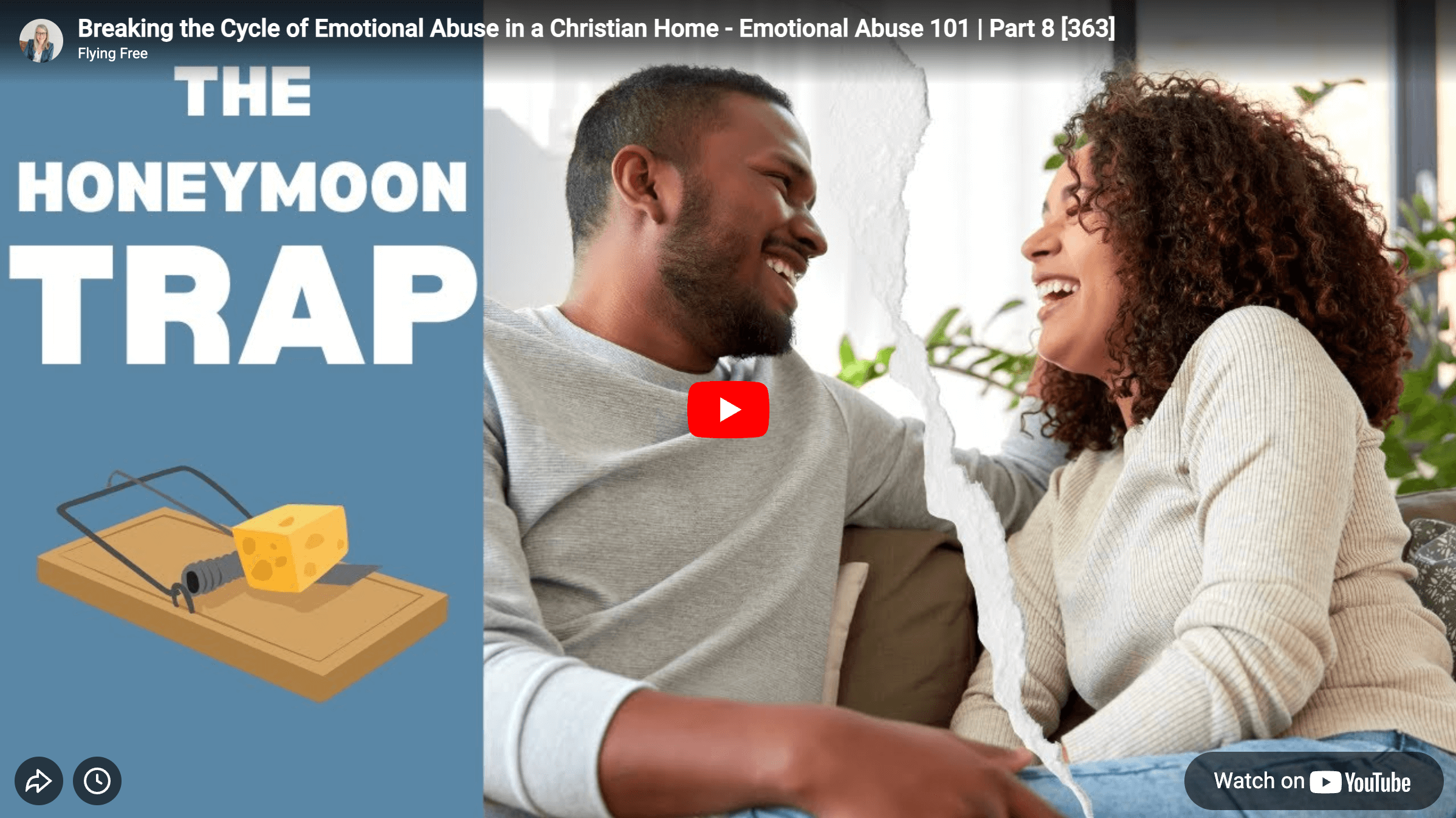
How do you actually break free from emotional and spiritual abuse in your Christian home?
Most Christian women stay stuck because nobody tells them the truth: breaking free requires three specific stages.
In this episode, you’ll find out why you keep falling for the “honeymoon phase” trap, what you need to do first before anything else, and why writing everything down literally saves your sanity. This isn’t feel-good advice. This is the actual path thousands of women have walked to get out and stay out.
Key Takeaways:
- Stage One is safety. Learn what that looks like.
- The abuse cycle speeds up over time: Tension builds, he explodes, then comes the honeymoon where he’s suddenly the man you married. Research shows this cycle gets faster and more violent the longer you stay.
- Write everything down: Keep a detailed abuse log with dates, quotes, and screenshots. This counters his gaslighting and becomes essential evidence down the road.
- You’re in the cycle too: When you feel hopeful after his apology, you’re caught in the honeymoon trap. Recognizing why you go back to the “hope drug” will be key to your ultimate freedom.
- Real freedom is peace without dread: It’s waking up without calculating how he’ll react to your existence. It’s making choices without permission. It’s living as yourself instead of his idea of who you should be
Relevant Links and Resources:
- I want to give you a free gift. It’s the audio version of my book, All the Scary Little Gods. It’s a spiritual memoir about healing from religious trauma and toxic programming that was not only destroying me, but also my children. You can listen to it FREE by going to scarylittlegods.com. I will also send you my weekly Hope Letters for Christian women in emotionally and spiritually abusive marriages.
- Check out the rest of the Emotional Abuse 101 series.
Article: Breaking the Cycle of Emotional Abuse in a Christian Home – Emotional Abuse 101 | Part 8
There’s a specific clinical framework for healing from emotional and spiritual abuse that actually works. And the frustrating truth? Most Christian women never hear about it.
Instead, you get handed generic advice. “Pray harder.” “Submit more.” “Just leave.” But no one walks you through the actual stages of recovery. No one explains what freedom requires or why you can’t skip steps.
Today, I’m giving you an evidence-based path that thousands of women have successfully walked before you.
What exactly is emotional and spiritual abuse?
Emotional abuse is a systematic pattern of interpersonal violence designed to give him complete power and control over you. And yes, I said violence. Because even though there might not be physical bruises, this kind of abuse damages your self-worth, your sense of reality, and your independence at a core level. It’s violence against your personhood that strips you of your purpose, meaning, and agency.
For those of you in faith communities, there’s an added layer. Spiritual abuse uses religious texts to justify control. “God will punish you if you don’t submit.” “The Bible says you need to shut up and obey me.” “You don’t get a voice because that’s being a nagging wife and women are to be silent.” “I’m your leader. You have to ask permission to do anything. I decide because that’s what the Bible says.”
This combination damages you in a particular way. Emotional abuse strips away your self-worth while spiritual abuse weaponizes your deepest moral framework and your relationship with God.
Clinically, this creates Complex Post-Traumatic Stress Disorder (C-PTSD). That’s important to understand because it tells us that recovery requires specialized, long-term trauma treatment. This isn’t something you can “get over” or fix with a few self-help books.
Why is it so hard to leave an abusive relationship?
It’s not because you’re weak. It’s not because you’re stupid. It’s not because you’re “not praying hard enough.”
It’s because you’re caught in a specific psychological pattern called the cycle of abuse.
Here’s how it works. Stage One is Tension Building. Your partner becomes increasingly controlling, argumentative, angry. You’re walking on eggshells, trying to keep the peace, accommodating his demands.
Stage Two is The Explosion. This is the major abusive incident. It might be verbal, emotional, spiritual. It’s usually the shortest phase, and the safest thing you can do during this time is just wait it out. (If he is physically hurting you, call 911.)
Stage Three is The Honeymoon. And this is the trap. After the explosion, he calms down. He becomes intensely apologetic, loving, kind. He promises to change. Maybe he even offers to go to counseling.
Suddenly, you see the person you fell in love with again. The mirage you want to believe (that releases dopamine in your body that you can get addicted to) comes into full focus, and you want it so badly that you ignore everything else and get swept back up into the cycle.
This honeymoon phase is what keeps you stuck. It gives you hope. It makes you think, “Maybe things really will get better this time.”
But here’s what research shows: The longer the relationship continues, the faster this cycle turns, and the more severe the abuse becomes during the explosion phase. He isn’t loosening control. He’s tightening it.
If you’re waiting for promised change, you need to hear this. The pattern itself tells you that change isn’t coming. Not without serious intervention and not while you’re still in the relationship.
What is Stage One of recovery and why can’t you skip it?
The clinical framework for healing from complex trauma follows Dr. Judith Herman’s Three-Stage Recovery Model. You cannot skip Stage One. You can’t jump straight to “processing your trauma” or “rebuilding your life” until you get safe first.
Stage One is all about Safety and Stabilization.
First, access immediate support if you’re in danger. If things are becoming life-threatening, call 911. But there are also confidential resources available 24/7. The National Domestic Violence Hotline is 1-800-799-SAFE. You can also text START to 88788 or chat at thehotline.org.
Second, create a safety plan. This is proactive strategy to minimize risk while you’re still living with your abuser or preparing to leave. Abusers often escalate their control and violence when they sense you’re preparing to leave, so preparation matters.
Secure your documents. Get copies of identification, birth certificates, prescriptions, financial records, and any evidence of abuse. Store them with a trusted friend or in a safety deposit box he can’t access.
Create digital separation. Change all your passwords. Get a separate device if possible for planning and communication. Consider getting a P.O. Box for important mail.
Plan for the kids. Teach them to recognize warning signs and know what to do during a violent incident. Inform trusted neighbors and ask them to call police if they hear abuse happening.
Build your financial foundation. Understand the full financial picture (debts, property, income, bank balances). If safe to do so, open a private bank account in your name only and start saving, even if it’s just small amounts.
Stage One also means learning to stabilize your emotions. After years of abuse, your nervous system is shot. You’re probably in a constant state of hypervigilance. Your body’s alarm system is stuck in the “on” position.
So you need to learn to manage strong emotions and reduce chaos. This is where therapeutic tools like grounding techniques, mindfulness, Dialectical Behavior Therapy skills, and cognitive behavior skills become essential. These aren’t just nice ideas. They’re the foundation that prevents you from getting overwhelmed when you start doing the deeper trauma work later.
Why is documentation so important?
One of the most insidious things about emotional and spiritual abuse is that it’s invisible. There are no bruises. No broken bones. Which means the burden of proof falls on you.
But here’s the other piece. The act of documenting directly counters his gaslighting. When you create an objective, readable record, you’re reclaiming the validity of your memory and experience. You’re reclaiming your reality.
Start keeping an abuse log. Keep it somewhere absolutely safe and inaccessible to your abuser. Include the date and time of each incident, detailed descriptions of what he said or did (direct quotes are valuable), how the incident made you feel, any witnesses, and screenshots of texts, emails, or tracking data.
Document spiritual coercion too. Misused scripture, threats related to faith or community. This matters because being part of a healing community means you can learn about Scriptures that misogynistic religious communities have historically used to control and abuse women, and you can reclaim them from the hands of religious abusers.
This documentation isn’t just for your own clarity. It’s essential for legal proceedings (protective orders, divorce, custody decisions). Many family courts take abuse allegations seriously, and detailed evidence can significantly impact outcomes.
What happens in Stage Two of recovery?
You’ve gotten safe. You’ve separated (physically, legally, financially). Your nervous system is beginning to stabilize. You’ve got some coping skills in place.
Now comes Stage Two: Remembrance and Mourning.
This is where you do the actual trauma work. This stage is hard. This is where you safely reconstruct what happened to you. Where you recall and articulate the details of the abuse without getting overwhelmed by it.
This is where trauma-focused therapies come in. Things like EMDR (Eye Movement Desensitization and Reprocessing) and Trauma-Focused Cognitive Behavioral Therapy. These are the gold-standard interventions for processing traumatic memories and reducing the intrusive symptoms of C-PTSD.
And then comes the mourning. Grieving for what you lost. The marriage you thought you had. The years you gave. The version of yourself before the abuse. The dreams that won’t come true.
This grief is real and necessary. You cannot skip over it. You cannot bypass it by staying busy or immediately jumping into a new relationship or focusing all your energy on your kids.
You have to let yourself feel it if you truly want to be free.
This is where having a therapist who understands complex trauma becomes absolutely critical. Because the pacing matters. You can’t rush through this material or you risk re-traumatization. Your therapist needs to help you process these memories in a way that integrates them without overwhelming you.
What does Stage Three look like?
Finally, you get to Stage Three: Reconnection and Integration.
This is where you transition from victim identity to survivor identity. Where you forge a new, integrated sense of self.
This isn’t about “forgetting” what happened or “moving on” as if none of it mattered. This is about integration. It’s about incorporating your experience into your life story without letting it define your present or future.
In this stage, you’re setting new life goals. Not goals based on what he allowed or didn’t allow, but goals based on what you want. Your actual desires. Your real dreams.
You’re re-engaging with the world. Getting involved in activities you enjoy. Pursuing interests and hobbies. Building a life that’s about more than just survival.
You’re building healthy relationships. And this is tricky because emotional abuse destroys your capacity for trust. So this means intentionally and slowly learning to trust again by carefully selecting safe, non-violent, trustworthy people to invite into your life.
This stage also includes holistic self-care. Physical care means moving your body, exercising, taking care of your health. Psychological trauma shows up physically because your nervous system has been chronically activated for years. Deliberate physical movement helps your body regulate.
Emotional care means continuing to work with your therapist, joining support groups with other survivors, and allowing yourself to feel the full range of human emotions without shame.
Spiritual care means reclaiming your faith outside the context of coercion. Finding or creating a spiritual practice that nourishes you rather than controlling you.
Social care means connecting with people who see you, hear you, and value you. Building a community that supports your growth rather than demanding your silence.
What does freedom actually look like?
It’s not perfection. It’s not a life without challenges or pain or hard days.
But it is a life where you trust yourself again. Where you can name your own reality without second-guessing whether you’re “crazy.” Where you have agency over your own decisions. Where you’re not walking on eggshells. Where you’re not constantly monitoring his mood to stay safe. Where you can pursue goals and dreams that matter to you. Where you can have relationships based on mutual respect rather than power and control.
Freedom looks like waking up in the morning without dread in your stomach. It looks like making decisions about your day without having to calculate how he’ll react. It looks like having conversations where you can express your thoughts without getting punished for them.
Freedom looks like peace. Real peace. Not the fake peace that comes from capitulating to his demands, but actual, sustainable peace that comes from living in alignment with your own values and treating yourself with dignity.
Can you break the abuse cycle while still in the relationship?
One of our Flying Free members wrote something that really captures this dilemma. She realized she was in the cycle too, not just observing his behavior.
When she’s feeling hopeful, relieved, connected with him, skeptical and doubtful of her perceptions, vowing to try harder, and confused about what’s going on, she’s reacting to the Honeymoon phase. When she feels anxious, withdrawn, isolated, trying to placate him, frustrated and angry, walking on eggshells, and wanting to run away and hide, she’s reacting to the Tension phase. When she gives in to him, feels trapped, degraded, hopeless, guilty, and yells back or slams doors, she’s reacting to the Explosion phase.
She asked: Can I take myself out of the cycle? Can I at least let the air out of its tires?
Her realization was this: she could get her focus off his behaviors and concentrate on hers. Practice mindfulness by getting her thoughts out of the past and future and onto the here and now. Do yoga. Do breathing exercises to calm herself. Make something with her hands. Do anything that counteracts what she usually does, says, and feels during each phase.
Another member responded with this truth: When you’re reacting, you’re buying in. You’re buying into his reality, his distortions. When you stop buying into their reality, you don’t have to react like their thoughts are legitimate. They’ve conned us into believing we have to adopt their reality. The abuse cycle is like a whirlpool that sucks us into seeing life through the same distorted lens they do.
Whatever you can do to see reality your own way is the key. Take off the distorted glasses he wears, stop believing him, and look at the world through your own eyes. For some of us, the only way to do this is by leaving, either physically or emotionally.
What if you feel overwhelmed right now?
That’s okay. You don’t have to do all of this today. You don’t have to have it all figured out.
But I want you to know this: There is a path forward.
If you want more support on this journey, I’d love to have you join us in the Flying Free program. You can learn more at joinflyingfree.com. We’re a community of Christian women walking this exact path together.
XOXO,
Natalie