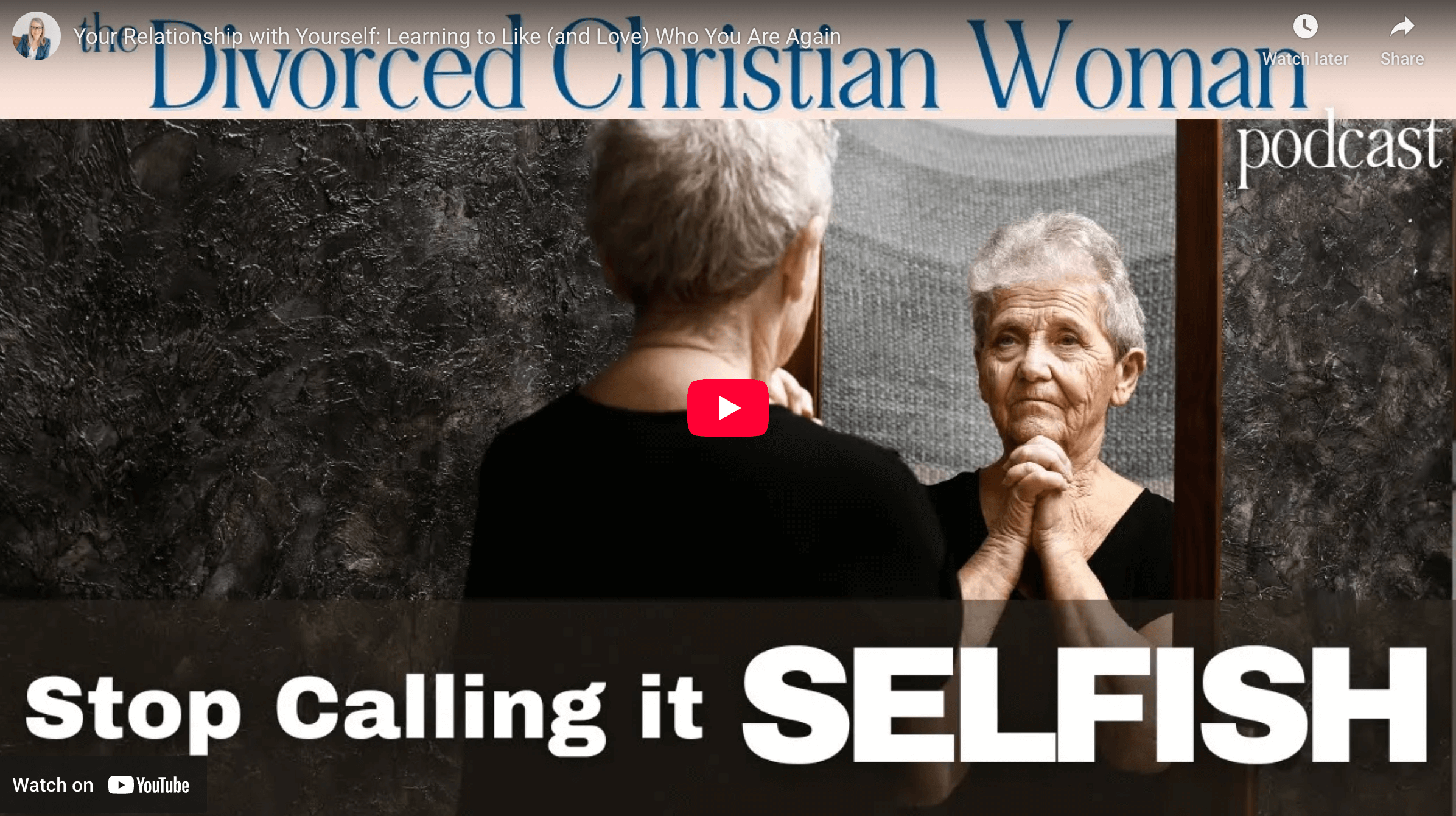
What if the most important relationship you’ll ever have isn’t the one with your ex, your pastor, or even your cat, but the one with yourself? (I know, scandalous.)
In this episode, I’m joined by three divorced Christian women, Barb, Diana, and Lisa, to unpack what it really looks like to reconnect with yourself after decades of religious programming and marital trauma.
We Talk About:
- Rebuilding your identity after your inner toddler’s been gagged and duct-taped by shame for too long
- Why self-love isn’t selfish
- How IFS (Internal Family Systems) can help you make peace with all the parts of you, even the hot messes and drama queens
- The sneaky inner critic that won’t shut up and how to lovingly calm her down
- Tiny, powerful ways to rebuild trust with yourself (without selling your soul to a Himalayan yoga retreat)
Whether you’re eight days or eight years post-divorce, this episode is your permission slip to stop apologizing for existing and start building a fierce, compassionate relationship with the one person who will always be there: YOU.
Related Resources:
- Flying Higher (https://joinflyinghigher.com) is my live mentorship program for Christian women pursuing increased confidence, emotional management, relational health and empowered self-development.
- Feel like a hot mess after divorce? This 5-Day Workshop will teach you a mind-shift tool to help you learn a powerful way to manage your thoughts and emotions in order to navigate adult decisions with clarity and peace.
- Check out Diana’s website and explore some resources, listen to her podcast, The Renew Your Mind Podcast, and finally, connect with her on Facebook and Instagram.
- Connect with Dr. Barb on her website, Integrative Coaching for Life.
- Read the book Lisa recommended, Hidden Within.
Article: Can You Really Love Yourself After Divorce? (Without Feeling Like a Heretic)?
What if the most important relationship you’ll ever have isn’t with your ex (hallelujah), your kids, your girlfriends, or even your favorite rescue cat, but with yourself?
I know. Take a minute. Breathe. The Christian programming just short-circuited and is trying to reboot.
Here’s the thing: I’ve learned through my own journey and from women like Diana, Lisa, and Barb, who shared their stories on my podcast, that loving yourself isn’t heretical. It’s actually the first step toward wholeness. And not the kind of “wholeness” you fake with red lipstick and perfect casseroles. I mean real, soul-deep, spine-straightening wholeness.
So let’s get into it, shall we?
What Lies Have You Been Believing About Yourself?
As Diana so vulnerably shared, many of us didn’t wait until after divorce to start dealing with the shame. We dragged it in with us. She said she had to untangle lies like:
- “I don’t deserve better.”
- “God calls me to suffer.”
- “If I leave, I’m not strong enough to hope for a miracle.”
Can we just pause and take that in?
Diana realized in a moment of Holy Spirit-inspired clarity that she wasn’t wrestling with God at all. She was wrestling with the lies she had internalized. And so are you.
Maybe it was the church. Maybe it was your upbringing. Maybe it was your spouse whispering you into a shell of yourself. But somewhere along the way, you stopped trusting your voice.
That ends now.
Isn’t Self-Love Just Christian Code for Selfishness?
Raise your hand if you were taught that loving yourself is the same thing as building a golden calf in your living room.
Lisa was. She told us how deeply ingrained the belief was that self-love = pride = hellfire. (Charming theology, isn’t it?)
But when everything around her collapsed after giving everything to everyone, God didn’t zap her. He wrapped her in unconditional love. And it changed everything.
Selfishness, as Diana reminded us (with a trusty dictionary definition, bless her), is “being excessively or exclusively concerned with oneself without regard for others.” That is not what you’re doing when you honor your limits, speak your truth, or choose peace over people-pleasing.
Self-love says, I matter too. Not, I matter more.
What the Heck Is IFS and Why Should You Care?
Let’s be honest. The idea of having “parts” inside you might sound a little bananas at first. But Dr. Barb Alhquist, a Level 3 certified IFS (Internal Family Systems) practitioner, broke it down beautifully on the podcast.
IFS is based on the idea that we all have inner parts like a family system inside us. You’ve met them:
- The inner critic that won’t shut up.
- The people pleaser doing cartwheels for approval.
- The scared little girl trying not to be abandoned again.
These parts aren’t “bad.” They’ve been trying to protect you in the only way they knew how. Barb explained that instead of bulldozing over these parts, we invite them into conversation with our “wise self, “our calm, compassionate inner leader.
And when we do this?
We stop reacting from our wounded places and start responding from our healed ones.
(By the way, I wrote a book called All the Scary Little Gods that teaches IFS in a creative, story-telling way that is very healing for Christian women. You can get it on Amazon, but I’d love to let you listen to the audio version for free. Just go HERE to sign up.)
How Do You Start Rebuilding Trust With Yourself?
You don’t trust someone who constantly abandons or belittles you, right? So if you’ve spent years gaslighting your own intuition, overriding your own boundaries, and believing your own inner critic, of course you don’t trust yourself.
But the good news? You can rebuild that trust.
Barb gave such a powerful framework for this:
- Take micro-moments of self-care. (She rubs her face cream in slowly and intentionally. It takes 30 seconds and tells her nervous system, “I’ve got you.”)
- Create internal boundaries. If a part of you wants to overshare and another part is like “hard pass,” don’t bulldoze. Listen to both.
- When your inner bully shows up, get curious. Lisa says, “Huh. That’s curious,” and responds with compassion instead of criticism.
Lisa even shared a story of tending to a young man on a train in Scotland (she’s a former nurse), and how the Holy Spirit gently nudged her: Why don’t you love yourself the way you just loved him?
Mic. Drop.
What If You’re Afraid to Start Healing?
Totally normal. Diana brought up a great point: our brains are wired to avoid pain, seek pleasure, and conserve energy. Healing work? Doesn’t tick any of those boxes up front. It’s hard, uncomfortable, and messy.
But so is staying stuck.
If you feel resistance to doing the work, ask yourself: “What am I thinking that’s keeping me stuck?” (Diana recommends asking: Is that thought true? Is it helpful? Is it honoring God?)
And then? Replace it with something grounded in truth, not fear-based fiction dressed up in religious language.
How Do You Know If a Thought Is From Your Inner Critic?
The inner critic isn’t always loud. Sometimes she’s sneaky. Diana shared some telltale signs:
- Constantly second-guessing decisions
- Feeling guilty for wanting rest or joy
- Replaying mistakes on a loop
- Believing you’re doomed to screw everything up
That voice might sound like “logic,” but it’s often just fear in Spanx.
Challenge it. Question it. Invite it to tea and say, “I see you. But I’m not letting you drive this bus anymore.”
What If You’re Still Not Sure You Can Do This?
Barb reminded us of something beautiful: slow is fast. You don’t have to tackle every part of yourself overnight. You don’t have to journal your way into enlightenment by Friday.
You just need to show up for yourself, in micro-moments.
Breathe during your hair dryer session. Sit down while you put on lotion. Say no when your system screams get out now (like I did during a particularly triggering conference moment).
These little things? They build sacred, sturdy trust with yourself.
Can You Be Both a Hot Mess and a Healer?
Yes. In fact, that’s the secret sauce.
As we said in the episode, when you learn to love your own broken pieces, you become someone who can hold space for others’ broken pieces too. You’ll stop judging. Start listening. And show up in ways that actually reflect Christ, not your old church’s version of Him.
That’s the point, right?
Want to Go Deeper Into This Work?
If your heart’s beating a little faster right now and your brain is like, “YES, but how do I even begin?” you’re not alone. And you don’t have to do this alone.
I coach Christian women like you inside Flying Higher, where we do exactly this kind of healing work with IFS, coaching, scripture, and a whole lot of sacred sass. Learn more at joinflyinghigher.com.
Want more goodness? My spiritual memoir All the Scary Little Gods is now available as a free audiobook, with a healing framework included.
So, can you really love yourself after divorce?
Absolutely. You can love the woman who stayed too long. You can love the parts of you that are still afraid. You can love the version of you that’s becoming something holy and whole.
God put you in charge of one person. Love her well. She’s been waiting for you.
XOXO,
Natalie