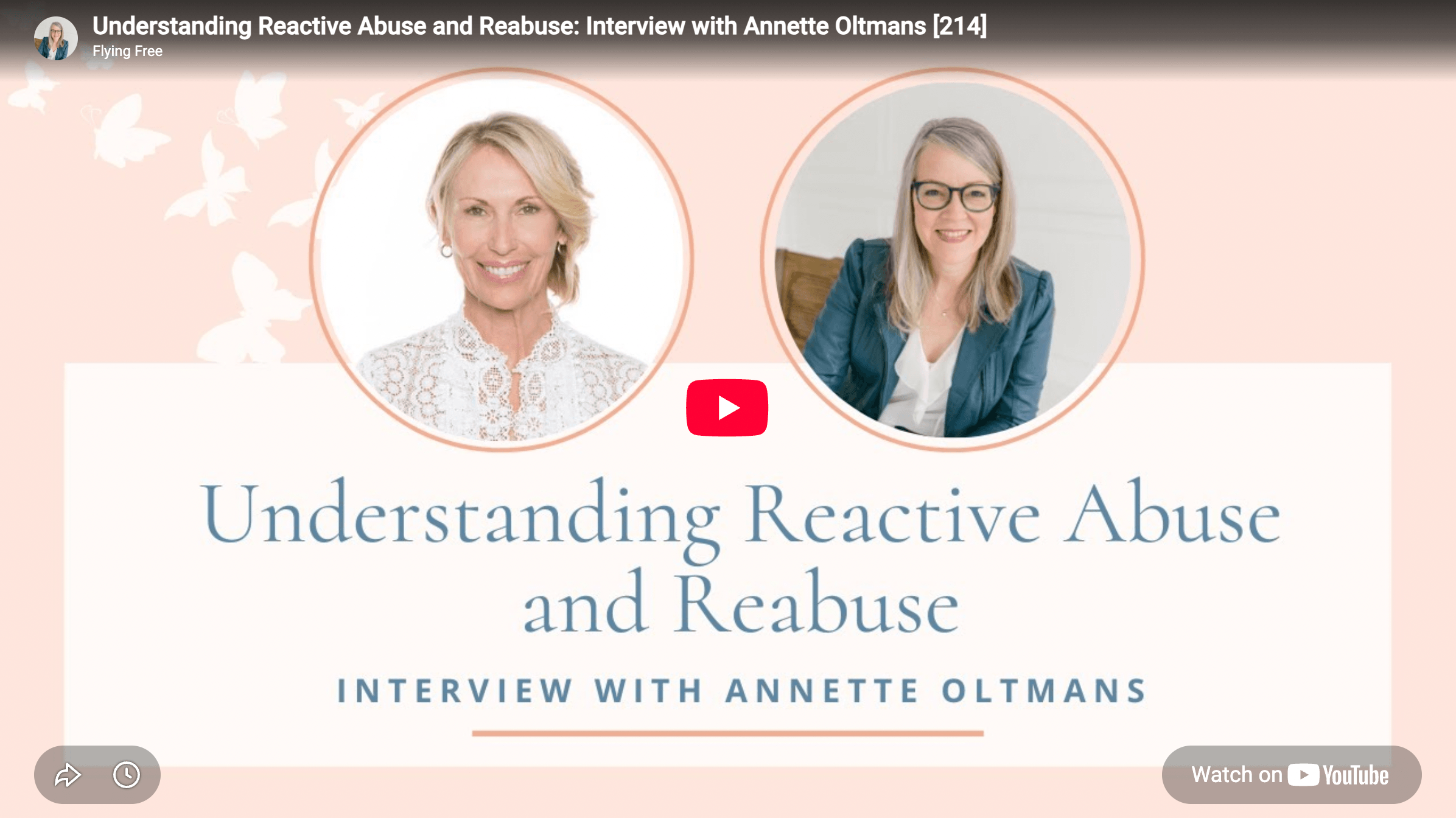
This is a replay of one of the most listened to episodes in the Flying Free Podcast archives, and it’s such a good one, I thought I’d reshare it for our new listeners!
If you’ve ever screamed, thrown something, said something you regret, and then wondered if you’re the abusive one, this conversation will clear that up for you. Our guest, Annette Oltmans breaks down what’s really happening in your brain, why “mutual abuse” is a myth, and what happens when the very people you turn to for help end up hurting you all over again.
What we cover:
- Why your reactions don’t match your character
- A phrase from the National Domestic Violence Hotline that settles the “mutual abuse” debate for good.
- A former police chief once confronted Annette with a question that reveals exactly why so many victims get misread.
- There’s a second wound that often hurts worse than the first one, and it usually comes from people inside the church.
- A simple physical trick can interrupt a trauma reaction before it takes over.
Get Today’s Free Resource:
📒 Take a free Emotional Abuse Assessment by going to emotionalabusequiz.com
I will also send you my weekly Hope Letters for Christian women in emotionally and spiritually abusive marriages.
Article: “What if I’m the Abuser?” Is There Such a Thing as “Reactive Abuse?”
Have you been accused of abusing your abuser by reacting to his nastiness?
This is especially common in Christian circles where women are expected to be demure and quiet and peaceable at all costs to their safety and sanity. I recently saw an Instagram post that said “Oh, I was a bitch to you? Did you forget I was nice and nice and nice and nice and nice and nice and nicest and nice again…THEEEEEEEEEENNNNNNN I was a bitch?”
Now I’m not saying we should all become bitches. I see a lot of reactions that are TOTALLY UNDERSTANDABLE by the way, and I think that angry energy is 100% part of our healing journey. But when we think we are only safe by embodying what it means to be an angry bitch all the time? That’s when we’ve just given our power away AGAIN, but on the flip side of the coin.
I’m still angry about stuff, but there is a way to be angry and channel that energy into good stuff. Into advocacy and changing ourselves and bringing love and influence to the loves of our lives whether that’s our children, our friends, family, etc.
I have a lot of patience, and I put up with a lot of crap, but eventually I do get to the end of what I am willing to take. And this happened when I was in my first marriage as well. Since I believed I was stuck, I felt trapped in that abuse cycle, and what do people or even animals do when they are trapped in a situation that is harming them day after day? They fight and claw back.
It’s like a cat in the corner with a big dog barking at her. She can’t get away, so she might try to hiss or take a defensive stance. Nobody is coming to her rescue, so she might try to fight back.
Can you imagine scolding the cat for being scared and defensive while coddling the dog? That’s what everyone in my life did at the time.
I didn’t know then that I could walk away. When I eventually figured that out, that’s exactly what I did. The cat slipped away, and everyone scolded the cat for not staying in her corner so the dog could keep having fun barking at her. In fact, they brought the dog inside and told the cat she was no longer welcome unless she was willing to keep letting the dog scare her.
No thanks.
Well, I didn’t know that this was a thing and that it had a name. Some call it “reactive abuse” but I don’t think that’s a very good name. Was the cat abusing the dog? Would we say a mugging victim is being abusive to her mugger if she has mace and sprays him? Of course not. So calling a victim’s reactions “abuse” is just another lie layered on top of all the other lies.
Annette Oltmans calls it reactive DEFENSE, and I agree with her. I interviewed Annette a few years ago, and it was one of the most listened to episodes on this podcast, so I’m resharing it with you today. I hope it is helpful for you and validates your experiences reacting to the harm that is chronically being done to you.
If anyone tells you your reactions are unfounded or over the top or wrong or whatever, let me tell you this: that person, if placed in the same circumstances for the same amount of time, would react in the same ways. Because that is how humans react to this kind of harm. Period.
Turns out your reactions are normal, and you are normal, and you just need a way out. That way out could be physically getting out, but that way out could just as well be emotionally and spiritually getting out which is what I help women do inside the Flying Free Kaleidoscope program. Learn more by going to joinflyingfree.com