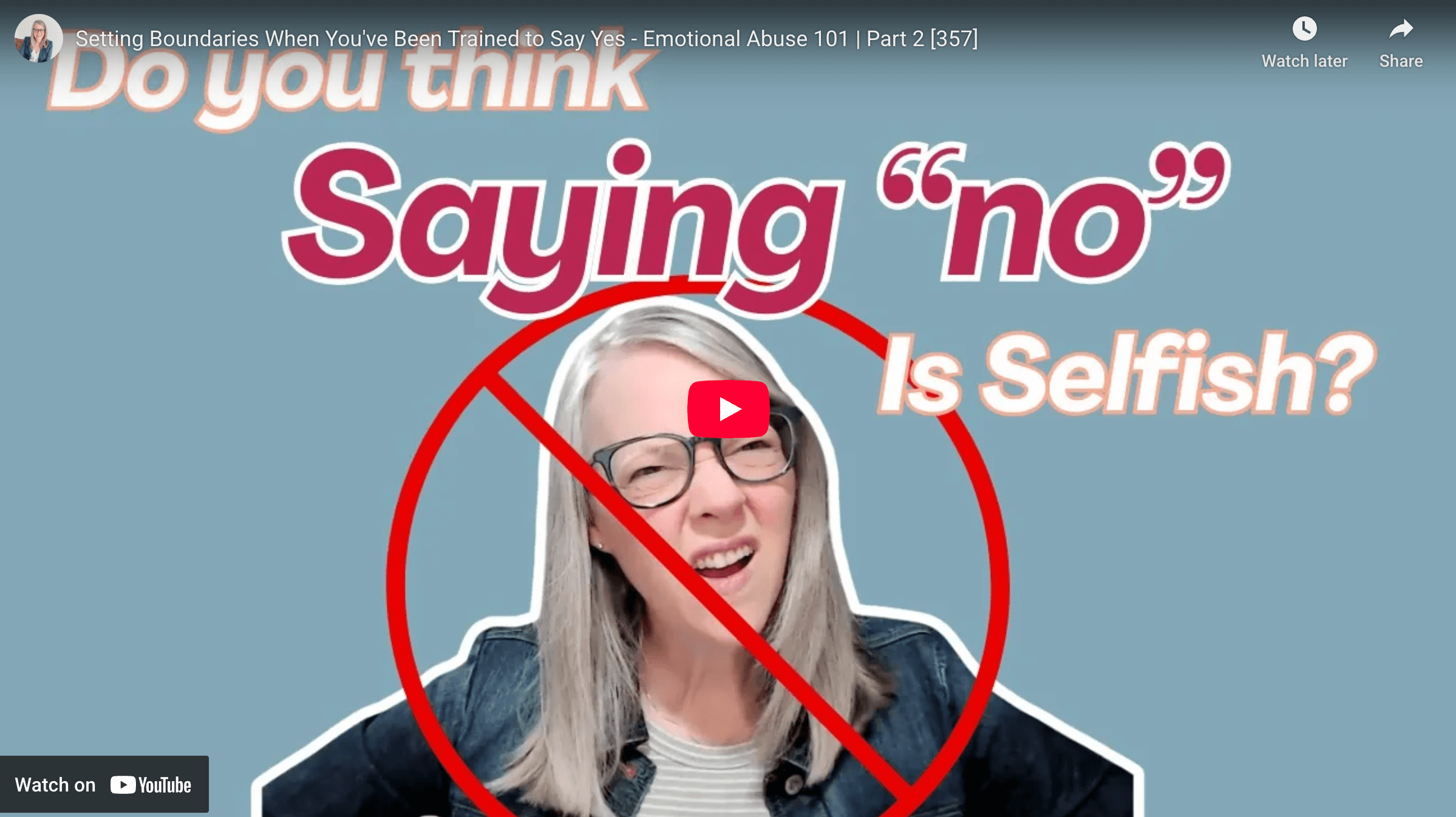
Have you ever been told that saying “no” makes you selfish? That good Christian women never rock the boat, always serve with a smile, and definitely do not have thoughts of their own?
This episode is Part 2 of our Emotional Abuse 101 series, and today we’re diving into the art of saying no.
If the idea of saying no makes your stomach flip or sends you into a guilt spiral, this episode is your lifeline. I’ll walk you through WHY it’s so hard to say no and HOW to start saying it anyway with confidence and without apology.
Key Takeaways:
- Saying no without guilt is an adult skill, not a rebellious sin.
- People-pleasing is often a trauma response. Your nervous system isn’t broken. It’s just been doing its job a little too well.
- You don’t need permission to have boundaries. You’re not waiting for anyone’s approval.
- Boundaries ≠ controlling others. Boundaries = choosing how YOU respond when others misbehave.
- There’s neuroscience behind this. Your brain can be rewired to feel safe even when saying no.
Related Resources:
- Check out the rest of the Emotional Abuse 101 series.
Article: The Art of Saying No (Without Guilt): How Christian Women Can Reclaim Their Boundaries and Their Power
If you’ve spent your life being praised for being agreeable, selfless, and endlessly accommodating, chances are you were never actually praised. You were used.
We were taught to say “yes” to everything: the casserole ministry, the controlling husband, the emotional toddlers (and no, I don’t mean the kids. I mean the grown men with jobs and Bibles who throw tantrums when you disappoint them).
We were brainwashed to believe that saying “no” made us rebellious Jezebels. But let me offer you a revolutionary thought: saying “no” isn’t sinful. It’s actually what healthy adults do.
What Even Is a Boundary, and Why Should You Care?
Think of boundaries as your personal property line. You wouldn’t let your neighbor park a broken-down van on your lawn and host tailgate parties in your garden, right? And yet, emotionally, we do it all the time.
Some of us were trained to have porous boundaries where we just mold ourselves to fit whatever someone else wants.
Others go rigid and build Fort Knox around their hearts. Neither extreme leads to flourishing. But healthy boundaries? They let the good in and keep the garbage out.
Boundaries are like traffic lights. You’re allowed to flash a red light when someone’s barreling toward your soul like a monster truck.
Why Does Saying “No” Feel So Dangerous?
Because it is to your nervous system. If you’ve been living in an emotionally or spiritually abusive relationship, your brain has likely been wired for survival. And survival often means fawning. People-pleasing isn’t a personality quirk. It’s a trauma response.
You’ve probably internalized the idea that if you say “no,” someone will rage, punish, leave, or claim you’re unsubmissive. But neuroscience, psychology, and Jesus all agree: your yes means nothing if your no isn’t allowed.
Aren’t Boundaries Just Another Way to Be Selfish?
This is my favorite lie. Somewhere in a dusty church basement, some men decided that God wanted women to be doormats. And somehow, that theology stuck like bad 90s hairspray.
Boundaries aren’t selfish. They’re sacred. They protect the imago dei in you. Jesus had boundaries. He said “no” to people. He disappeared into the wilderness. He refused to let other people’s drama dictate His direction.
What Happens When You Finally Start Saying No?
Let me paint you a picture: You say no. The world does not implode. Your church ladies might gossip, your husband might pout, and your mother-in-law might clutch her pearls, but YOU will breathe. Deeply. For the first time in years.
Here’s the kicker: people who were benefiting from your lack of boundaries will be the ones who throw tantrums when you finally set some. This tells you everything you need to know about their motives. Healthy people respect boundaries. Controllers see them as obstacles to their control.
Can You Really Say “No” Without Explaining Yourself?
Yes. And it might just be the most grown-up thing you do this year.
You don’t owe anyone a 10-point PowerPoint presentation defending your choices. You can say, “No, thank you.” You can say, “I’m not available.” You can say, “I don’t discuss that.” And then? Let the silence do the heavy lifting.
Want bonus points? Practice saying it in the mirror. (Yes, I’m serious. Cognitive behavioral therapy backs this up. Mirror talk rewires the brain. Viola Davis did it. So can you.)
What If You’re Still Living With Your Abuser?
Then your number one priority is safety, not winning boundary gold stars.
You may need to be strategic. Some boundaries (especially the verbal ones) can provoke an abuser. In that case, nonverbal boundaries like removing yourself from the room or disengaging emotionally might be safer. Calling the police is absolutely appropriate if you’re being physically blocked or threatened.
And sometimes, the ultimate boundary is leaving altogether. Yes, I said it. And no, that doesn’t mean you’re giving up on God. It means you’re refusing to be someone’s emotional punching bag while they sing worship songs on Sunday.
What If People Say You’re Not Trusting God?
I love this one. Because apparently, trusting God means doing nothing while someone destroys you emotionally, spiritually, and sometimes physically.
But what if trusting God actually means using the voice, wisdom, and common sense He gave you? What if it means stewarding your body and soul like the sacred creation they are?
God doesn’t micromanage you. He doesn’t override your will. He doesn’t say, “Well, I gave her freedom, but let’s make sure she stays in that dumpster fire of a relationship so I look sovereign.” No. God honors your freedom. Even if your church doesn’t.
What’s the First Step Toward Healthy Boundaries?
Here’s your assignment: start noticing when you feel resentful or taken advantage of. That’s your body waving a red flag. Ask yourself: What boundary is missing here? And then start practicing it on paper, in the mirror, with a safe friend.
Say things like:
- “I’m not available for that.”
- “I won’t continue this conversation when I’m being yelled at.”
- “I need to step away right now.”
You don’t need permission. You don’t need approval. You need courage.
But Isn’t It Scary to Set Boundaries?
Yes. Because you might lose people. You might lose fake friends. You might lose toxic relationships. But you’ll gain something priceless: you.
Author Glennon Doyle once said she feared saying “no” would make people stop loving her. And you know what? Some did. But the ones who stayed? They were the real ones.
And let’s be real: anyone who demands your silence, servitude, or self-erasure in order to stay connected to you isn’t loving you. They’re using you. And you? You are not a vending machine of affirmation, sex, dinners, and compliance.
Are You Ready to Reclaim Your Power?
Boundaries are a declaration: “I matter.” They’re how we tell our nervous system, “I’ve got you.” They’re how we reparent the wounded girl inside of us who was taught that she had to be small to be safe.
You were never meant to shrink. You were made to soar.
And if you want help rebuilding those wings? Come join us inside Flying Free. We’ve got a whole course on boundaries and a sisterhood of women who are learning, just like you, to say no with love and without guilt.
Because freedom isn’t found in fear. It’s found in truth.
And the truth is, you’re worth protecting.
XOXO,
Natalie