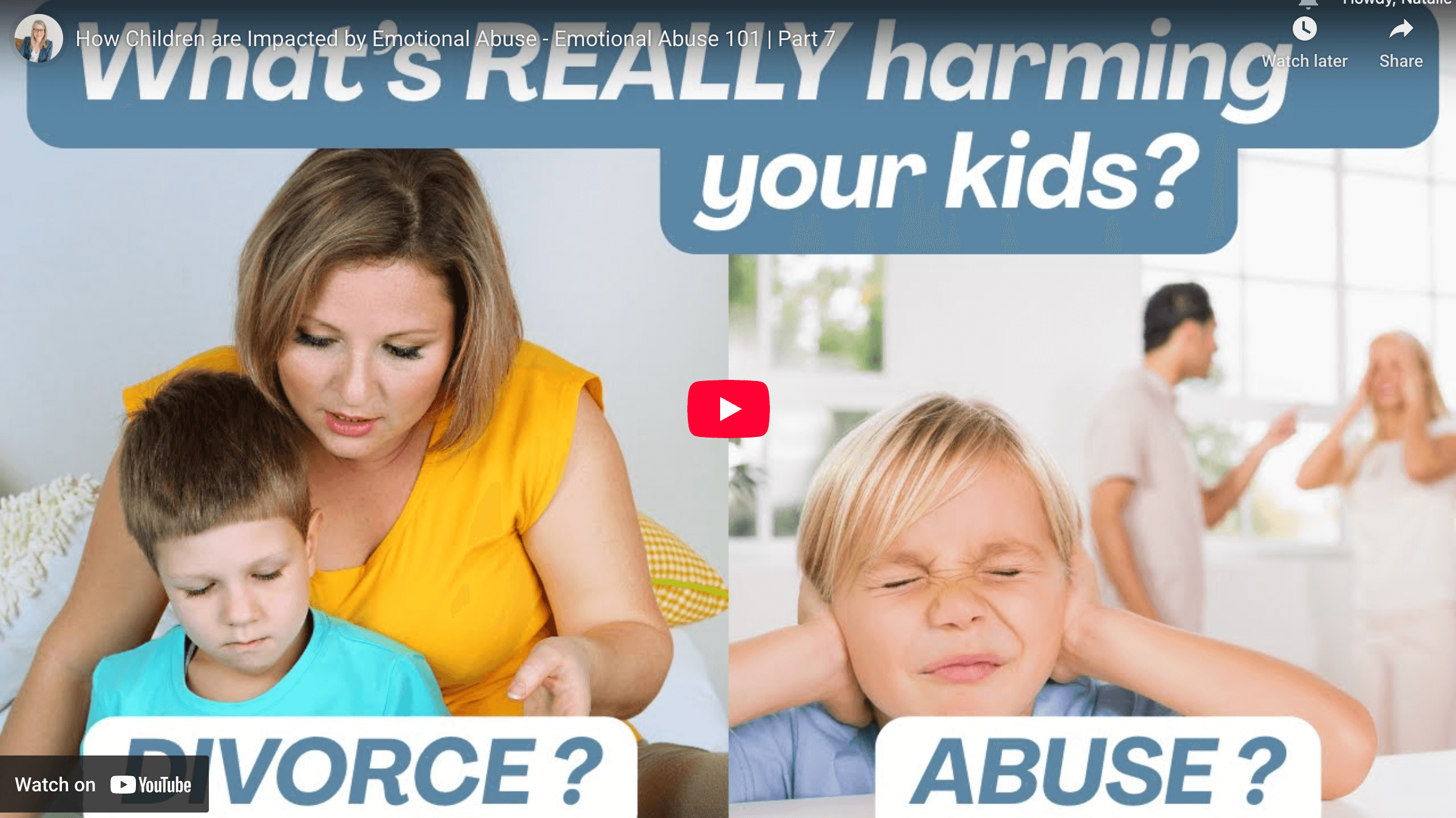
If you’ve been told that staying married “for the kids” is the most loving choice you can make, this episode will challenge everything you thought you knew about protecting your children.
The truth is, emotional and spiritual abuse doesn’t just harm you, it rewires your children’s brains, damages their attachment systems, and poisons their relationship with God. Research shows that staying in a high-conflict, abusive marriage can be up to 10 times more damaging to children than divorce. And when abuse is wrapped in religious language, the harm multiplies. Your kids aren’t just losing safety, they’re losing their ability to experience God as loving and trustworthy.
Key Takeaways:
- Emotional abuse causes documented brain changes in children: Studies show literal changes in brain development, delays in developmental milestones, and difficulty processing positive feedback.
- Children don’t have to be direct targets to be harmed: Simply living in an environment of coercive control, manipulation, and contempt creates lasting damage.
- Spiritual abuse acts as a multiplier: When abuse is justified with God’s name or Bible verses, children develop profound guilt, anger at God, and the belief that God is punishing and untrustworthy.
- Divorce isn’t the problem – conflict is: Research shows that 80% of children from divorced homes grow up healthy and successful when at least one parent provides safety and stability.
- You can be the protective factor: One safe, emotionally attuned caregiver can change everything. Your healing and presence matter more than a legal document keeping the family “intact.”
Relevant Links and Resources:
- Check out the rest of the Emotional Abuse 101 series.
- I want to give you a free gift. It’s the audio version of my book, All the Scary Little Gods. It’s a spiritual memoir about healing from religious trauma and toxic programming that was not only destroying me, but also my children. You can listen to it FREE by going to scarylittlegods.com. I will also send you my weekly Hope Letters for Christian women in emotionally and spiritually abusive marriages.
Article: How Will My Husband’s Emotional Abuse Harm My Children?
If you’ve spent years minimizing what’s happening in your home because “at least he doesn’t hit me” or “at least the kids aren’t being physically hurt,” I need you to hear this: emotional abuse rewires children’s brains.
Research consistently shows that emotional neglect and abuse can be as harmful, and sometimes more harmful long-term, than physical or sexual abuse. Studies document literal changes in brain development. Delays in hitting developmental milestones. Learning problems. Difficulty processing positive feedback.
Kids in emotionally abusive environments develop insecure attachment styles. They struggle with trust, self-worth, and regulating their own emotions. And these struggles don’t just disappear when they turn 18. They follow these kids into adulthood, showing up as higher rates of depression, anxiety, PTSD, personality disorders, substance use, academic failure, unemployment, and chronic health problems.
Here’s something else that matters: Children don’t have to be the direct target of the abuse to be harmed by it. If your husband is coercively controlling you, even covertly manipulating you through verbal aggression, intimidation, contempt, or any of the patterns we’ve talked about in this series, your children are swimming in that toxic environment. And it’s damaging them.
How Does Spiritual Abuse Harm Children?
Yes. Spiritual abuse acts as a multiplier of emotional abuse.
When abuse happens inside a religious framework, it doesn’t just damage children psychologically, it damages them spiritually. And that spiritual damage creates an additional layer of harm that can take decades to untangle.
Spiritual abuse of children sounds like: “God says you must obey or you’re sinful and rebellious.” “God’s going to punish you if you tell anyone about this.” It’s framing control and cruelty as biblical or God’s will.
In these homes, spiritual abuse almost always overlaps with emotional abuse. The shaming, the scapegoating, and the constant criticism all gets wrapped in religious language. And that does something particularly damaging: it hijacks a child’s relationship with God.
Research on spiritual injury shows that abused children often develop profound guilt, anger at God, fear of death, and the belief that God is unfair, punishing, or untrustworthy. When abuse is religiously justified such as when a child hears “God wants this” or “the Bible says you deserve this,” outcomes are often worse than if you take the same abuse without that religious framing. Higher levels of depression. Higher anxiety. More PTSD. More aggression.
Think about what that means. These children aren’t just losing safety in their homes. They’re losing their sense of who they are in relation to God. They’re losing their ability to experience their Creator as loving and trustworthy. They’re losing the one source of comfort and hope that should be available to them through the hardest things in life.
But Isn’t Divorce Worse for Kids?
Here’s the propaganda you’ve been sold: Divorce equals damage. Intact family equals healthy children. Therefore, stay married no matter what.
Yes, divorce is hard on kids. Research confirms that most children experience emotional pain and disruption when their parents divorce, especially in the first two years. They’re adjusting to two different homes, custody arrangements, maybe changing schools. That’s real. That’s painful.
Children of divorce do show somewhat higher rates of academic struggles, behavior problems, and emotional distress compared to children from low-conflict, continuously married families.
But here’s what those statistics don’t tell you: About 80% of children from divorced homes do not suffer serious lifelong problems. They adapt. They adjust. They grow up to be successful, healthy adults.
And the biggest predictor of how children fare isn’t whether their parents are divorced. It’s the level of conflict before the divorce, during the divorce, and after the divorce.
Much of the increased risk we see in children of divorce is actually linked not to the divorce itself, but to the conflict they were already experiencing in the home.
Studies show that children raised in high-conflict or abusive homes can have outcomes up to 10 times worse if parents stay together than if they divorce.
In fact, some researchers describe divorce after a high-conflict marriage as a “stress relief event” for children. When the conflict drops and at least one home becomes stable and safe, children’s adjustment often improves over time.
The divorce doesn’t damage them. The divorce rescues them.
What Are Adverse Childhood Experiences, and Why Do They Matter?
Researchers study something called adverse childhood experiences, or ACEs. These are traumatic events in childhood that increase lifelong health risks.
Witnessing domestic violence is an ACE. Experiencing direct emotional abuse is an ACE. Living with a parent who has mental health struggles or an addiction is an ACE.
And here’s the thing: ACEs stack. The more ACEs a child experiences, the higher their risk for lifelong health problems, mental health struggles, substance abuse, and relationship difficulties.
Divorce, all by itself, is one ACE.
Staying in an abusive marriage loads multiple ACEs onto your child’s life year after year after year.
What If I Can’t Leave Right Now?
I know some of you aren’t in a position to leave. At least not right now. Maybe down the road you might be able to, but right now you’re just not there.
I don’t want this information to bring you shame or overwhelming fear. Because here’s the truth: There are ways you can mitigate these harmful effects.
The research identifies several protective factors that consistently buffer children from the impacts of both abuse and divorce. And the most powerful one is something you can provide: You.
Children need at least one safe, stable, emotionally attuned caregiver. One person who believes them. Who offers consistent support. Who is present and responsive.
That person can change everything. In the midst of chaos and dysfunction, one safe relationship can become an anchor point that helps a child develop resilience and hope.
That’s you. You can be that person.
But you need to become the version of yourself that you need to be for your kids. You need to heal. You need to get the emotional stability skills for yourself so you can model that for your kids and be that emotionally stable parent.
Beyond that safe relationship, other protective factors include reduced exposure to conflict (this is where concepts like parallel parenting become important), access to trauma-informed mental healthcare, supportive family members, faith communities that affirm safety rather than pressure reconciliation at all costs, and schools that provide predictable structure.
For children who have experienced spiritual abuse, they may need support in reconstructing a healthier view of God. They need to separate their abuser’s voice from God’s voice. They need to reclaim their faith as a source of comfort and hope instead of fear and guilt.
What Does Recovery Actually Look Like?
Here’s something hopeful: Most children will recover from the initial disruption of divorce within about two years when they have appropriate support and at least one safe home.
Many children of divorce grow up to be independent, resourceful, compassionate adults who build meaningful lives. The story doesn’t have to end with trauma. There’s a whole life ahead of them.
For children coming out of spiritually abusive homes specifically, healing often requires adults who will explicitly validate that the misuse of the Bible was wrong. Kids need someone to say: That was not God. That was your father using God’s name to hurt you.
They need people who will model non-coercive, compassionate faith. Who will show them that spirituality can be about love and hope and peace—not control and fear.
What Are You Really Choosing?
You’ve been told you have two options: Stay married and give your kids a stable home, or divorce and damage them forever.
That’s a false choice. It’s a framework built on incomplete information and theology that puts institutional marriage above human beings.
The real choice in front of you isn’t “intact family versus broken family.”
The real choice is: Do I continue exposing my children to an environment that research shows is harming their brains, their emotional development, their attachment systems, and their relationship with God? Or do I make the hard, painful, courageous choice to create safety for them—even though that safety comes in a different package than I once imagined?
I’m not going to pretend leaving is easy. There is grief involved, even when it’s the right decision. You’re going to grieve the family you hoped you would have. Your children are going to grieve too. The first two years are going to be rocky.
But grief is not the same thing as damage. Grief is clean pain. Damage is dirty pain. Hard feelings are not the same thing as harm.
Your children can experience the sadness of divorce and still be healthier, safer, and more whole than they would’ve been staying in a home full of contempt, lies, control, guilt, and fear.
Also, your kids are watching you. They’re learning from you what love is supposed to look like. What marriage is supposed to look like. What it means to be a woman. What it means to be a man.
When you leave, you’re saying: That’s not okay. Human beings deserve better. We matter. Safety matters. It’s possible to choose safety without being selfish.
You end up breaking the cycle and changing the whole story—not just for yourself, but for generations to come.
If you need support as you navigate these decisions, I’d love to invite you to join Flying Free. It’s a trauma-informed community where you can get the skills, support, and clarity you need to become that safe, stable parent your children need. You can learn more at joinflyingfree.com.
XOXO, Natalie
Sources:
- Long-term Health Outcomes of Childhood Abuse – NIH (PMC) https://pmc.ncbi.nlm.nih.gov/articles/PMC1494926/
- Emotional Abuse, Neglect May Be More Harmful Long-Term Than Physical or Sexual Abuse – University of Iowa / UI Health Care https://uihc.org/childrens/news/emotional-abuse-neglect-may-be-more-harmful-long-term-physical-sexual-abuse
- How Emotional Abuse in Childhood Changes the Brain – Verywell Mind https://www.verywellmind.com/childhood-abuse-changes-the-brain-2330401
- Long-term Effects of Child Abuse and Neglect on Emotion Regulation and Health – NIH (PMC) https://pmc.ncbi.nlm.nih.gov/articles/PMC4117717/
- Long-Term Consequences of Child Abuse and Neglect – U.S. HHS / PDF https://www.hhs.nd.gov/sites/www/files/documents/DHS%20Legacy/long-term-consequences-of-child-abuse.pdf
- Long Term Effects of Child Abuse and Neglect – Prevent Child Abuse America https://preventchildabuse.org/latest-activity/long-term-effects-of-child-abuse-and-neglect/
- The Long-Term Effects of Domestic Violence on Children – Loyola University Chicago Law Journal (PDF) https://lawecommons.luc.edu/cgi/viewcontent.cgi?article=1232&context=clrj
- Effects of Domestic Violence on Children – WomensHealth.gov (U.S. HHS) https://womenshealth.gov/relationships-and-safety/domestic-violence/effects-domestic-violence-children
- Parental Conflicts and Posttraumatic Stress of Children in High-Conflict Divorce – NIH (PMC) https://pmc.ncbi.nlm.nih.gov/articles/PMC9360253/
- The Interactive Effects of Marital Conflict and Divorce on Parent–Child Relationships – NIH (PMC) https://pmc.ncbi.nlm.nih.gov/articles/PMC2882314/
- High-Conflict Divorce and Child Adjustment (Future of Children PDF often cited in this area) https://childabusecondonedbyfamilycourt.pbworks.com/f/high+conflict+future+of+children.pdf
- Risk factors for child harm in the context of family violence – Department of Justice Canada https://www.justice.gc.ca/eng/rp-pr/cj-jp/fv-vf/rfcsfv-freevf/p4.html
- Divorce and Family Violence – TexasLawHelp.org https://texaslawhelp.org/article/divorce-and-family-violence
- The Impact of High-Conflict Divorces on Children – Coker Legal (2024 overview) https://www.cokerlegal.com/blog/2024/february/the-impact-of-high-conflict-divorces-on-children/
- How Child Abuse Impacts Adulthood – Youth Villages https://youthvillages.org/how-child-abuse-impacts-adulthood/