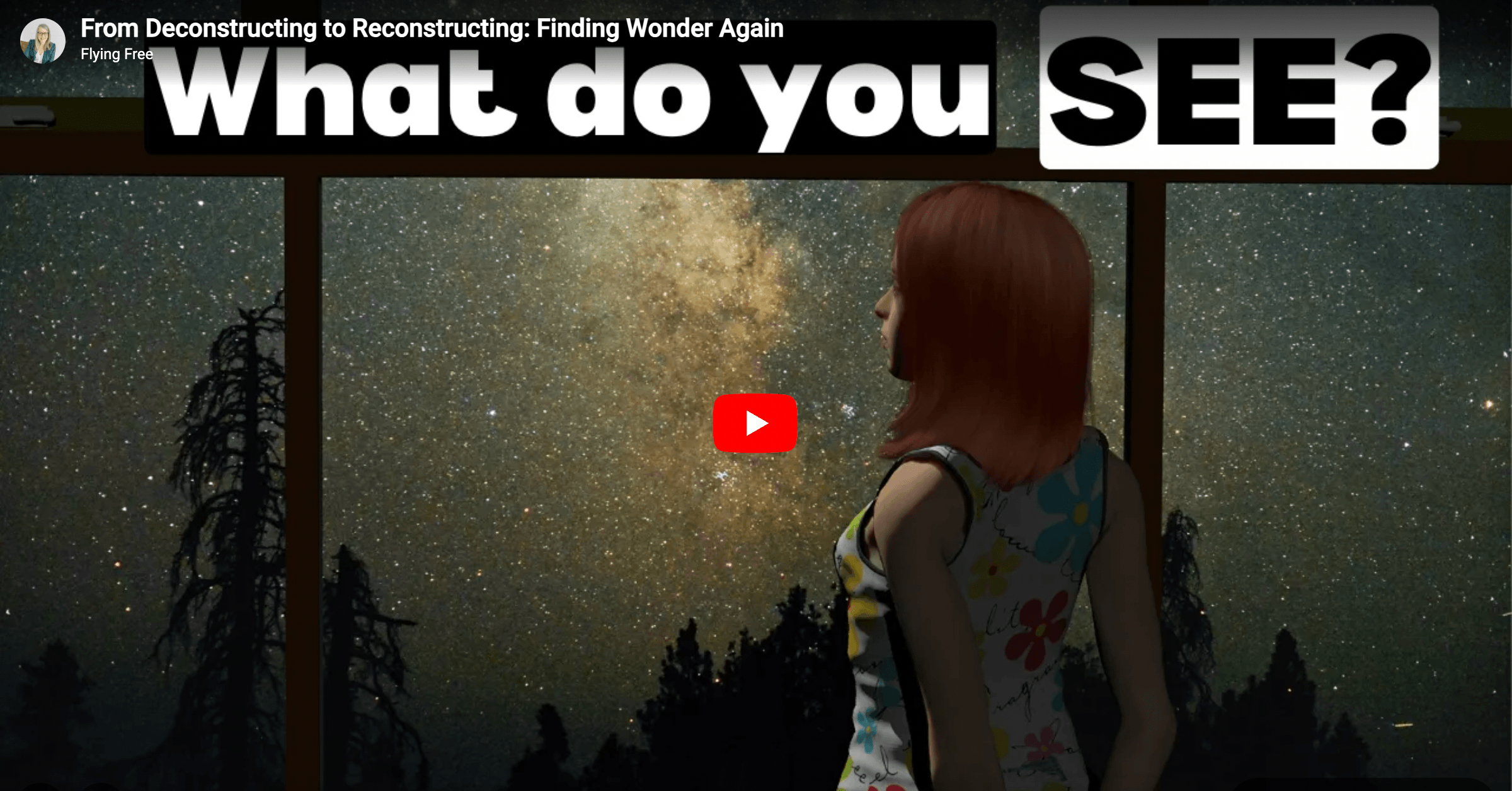
This is one of my favorite interviews! Today I’m talking with my friend, Dr. Tiffany Yecke Brooks, author of Gaslighted by God, Holy Ghosted, and her brand-new book, To Rebehold the Stars: Reimagining Faith After Deconstruction.
If you’ve walked through the painful process of deconstructing the toxic theology you inherited, this conversation is going to knock your socks off.
Drawing from Dante’s Inferno (I know, right?!), classical literature, and deep theological study, Tiffany shows you how to create a new spiritual lexicon that actually reflects the heart of God.
(Listen to find out what that even is!)
This isn’t about burning it all down. It’s about holding up each piece to the light and deciding: Does this stay or go?
Key Takeaways:
- The one thing fundamentalism can’t tolerate (and why that’s actually your doorway to freedom)
- What Dante’s Inferno has to do with your faith journey, and why the final line matters so much
- The Greek word that completely reframes what forgiveness actually means
- Why the images you were given for God might be keeping you stuck in an outdated script
- What happens when you stop trying to be perfect and start focusing on being good
Resources mentioned:
- Tiffany’s Substack Newsletter (but only if you like to laugh – otherwise stay away)
- Her new book: To Rebehold the Stars: Reimagining Faith After Deconstruction.
- Her OTHER interviews with me (all AMAZEBALLS):
- The book Dr. Brooks copy-edited for me AND that is a perfect illustration of what her book Holy Ghosted is talking about: All the Scary Little Gods
- And hey – listen to my book FREE by going to scarylittlegods.com!

Tiffany Yecke Brooks is the lead or contributing writer on more than two dozen books, including multiple New York Times bestsellers. She is the coauthor of Fear Is a Choice: Tackling Life’s Challenges With Dignity, Faith, and Determination (with NFL running back James Conner), Limitless: The Power of Hope and Resilience to Overcome Circumstance (with Paralympic gold-medalist Mallory Weggemann), and the narrative nonfiction historical thriller Espionage and Enslavement in the Revolution: The True Story of Robert Townsend and Elizabeth (with historian Claire Bellerjeau). Her newest book, To Rebehold the Stars: Reimagining Faith After Deconstruction, was released in March 2026 by Eerdmans. She has also published articles in peer-reviewed journals and the Smithsonian.Tiffany holds a PhD from Florida State University, where her dissertation covered, in part, cultural adaptations of stories from the book of Genesis, and an MA from the University of Bristol in the UK, where her thesis examined cultural influences and literary techniques in the Gospel of Luke. A popular speaker for student groups, faith conferences, and academic lectureships, Tiffany has taught literature and writing at Abilene Christian University, McMurry University, and the University of South Carolina – Beaufort.
Article: From Deconstructing to Reconstructing: Finding Wonder Again
So you’ve done the work. You’ve questioned everything. You’ve dismantled the toxic theology that kept you small, silent, and spiritually imprisoned.
But now you’re standing in the aftermath, looking at all the pieces scattered around you, and the question hits: What now?
Because deconstruction breaks things apart, but nature, spiritual or otherwise, abhors a vacuum.
Something will fill those empty spaces. The question is: Do you want to leave it to chance, or do you want to be deliberate about what you rebuild?
My friend Dr. Tiffany Yecke Brooks has written a stunning new book called To Rebehold the Stars, and it’s all about this exact moment in your faith journey. The title comes from the final line of Dante’s Inferno: that moment when Dante and Virgil climb out of hell, emerge on the other side of the world, and look up to see the stars again.
Why Does Wonder Matter After Deconstruction?
Here’s what fundamentalism and evangelical Christianity demand from you: answers. Certainty. A tidy theological box with no room for mystery.
But here’s the truth: The theology of wonder is the antidote to that suffocating certainty.
When you cultivate wonder and open yourself up to the possibility that God is infinitely bigger, more mysterious, and more beautiful than you were ever taught, you create space for healing. You give yourself permission to not know. To seek. To pursue rather than possess.
And honestly? That’s so much more exciting than having all the answers.
Think about a child walking into a planetarium for the first time. That wide-eyed “whoa” moment. That’s what a healthy theology should feel like. Not someone walking into a room and saying, “Yeah, I know all this already.”
The moment you claim to have God fully figured out is the moment you’ve made God too small.
What Does It Mean to Create a New Spiritual Lexicon?
This might sound nerdy (and Tiffany will be the first to admit she’s a word person), but the language you use for God actually shapes the way you think about and experience God.
It’s not just about words. It’s about images, metaphors, experiences—all the things that create a framework for how you relate to the Divine.
Here’s an example: The word salvation in Greek is soteria, which literally means liberation. Not “saved from hell someday.” Liberation. Freedom. Something you can experience right now, today, in your actual life.
Doesn’t that just shift something inside you?
Or how about fasting? You were probably taught that fasting means skipping lunch to prove your devotion. But if you read Isaiah 58, God makes it pretty clear: The fast I want is for you to loose the bonds of injustice, let the oppressed go free, share your bread with the hungry, and stop hiding from your own kin.
That’s not about self-denial. That’s about power-sharing. That’s about making sure others have enough.
Suddenly, fasting becomes something much bigger and more beautiful than whether or not you ate breakfast.
And that’s the power of language. When you reframe the words and metaphors you’ve been given, you start to see God differently. You start to relate to God in a way that actually resonates with your soul, not just the doctrinal script someone handed you.
Can You Still Believe After Deconstruction?
Let me be clear: Tiffany wrote this book for people who are deconstructing religion, not deconstructing God.
There’s a difference.
Some people deconstruct and walk away from faith entirely, and that’s their journey. But this book is for those of you who still believe. Who still sense the presence of the Divine. Who want to build your life on a foundation of faith but not the toxic, abusive, soul-crushing version you were given.
You’re looking at each piece of your old belief system and asking, “Does this reflect the heart of God? Is this something I want to carry forward? Or is this something I need to release?”
That’s the work of reconstruction. And it’s sacred work.
You’re not just passively accepting what you were handed. You’re actively choosing what you believe. You’re building a faith that’s yours.
What If I Accidentally Rebuild the Same Toxic Beliefs?
This is such a real fear, and Tiffany addresses it directly in the book. She says, “We need to be careful not to recolonize our faith with old ideas that we’ve outgrown and that are no longer consistent with our understanding of who God is.”
The easiest thing in the world is to slip back into old patterns when you don’t know what else to do. That’s why this process has to be deliberate.
You don’t have to have everything figured out. Your faith should always be under negotiation. You should constantly be asking, “Does this still ring true? Is this still consistent with the heart of God as I understand it now?”
But you do need to be intentional about what you’re rebuilding. Otherwise, you’ll wake up one day and realize you’ve rebuilt the same cage you just escaped from.
How Do I Even Start Rebuilding?
Start with wonder. Start with the possibility that God is bigger, kinder, more mysterious, and more beautiful than you were ever allowed to believe.
Start by reexamining the language you use for God. What images were you given? A lion? A judge? A king?
Those are fine, but they’re not the only images in Scripture. God is also compared to a mother bear protecting her cubs. A woman in labor. The “many-breasted one” (that’s what El Shaddai can mean, by the way, not just “Almighty God” but “the nurturing provider”).
What if you gave yourself permission to relate to God as Mother? As Comforter? As the family you never had?
What if you let yourself imagine God in ways that actually resonate with your soul instead of just repeating the script you were handed?
When you do this work, when you reconstruct your faith with intention and wonder, you’re not just healing yourself. You’re modeling for the next generation what it looks like to have a faith that grows, matures, and deepens over time.
You’re showing them that doubts and questions aren’t sins, they’re invitations to know God more fully.
What About Forgiveness?
I have to share this because it’s one of the most powerful sections in Tiffany’s book.
The Greek word for forgiveness is aphiemi, which literally means “to separate” or “to divorce.” It’s the same word used for divorce in the New Testament.
Let that sink in.
Forgiveness doesn’t mean pretending it didn’t happen. It doesn’t mean staying in proximity to someone who shattered your spirit. It might actually mean separating yourself from the harm.
You’re allowed to separate yourself from harm. You’re allowed to set boundaries. You’re allowed to rebehold the stars without dragging the people who tried to keep you in the cave along with you.
If you’ve been through deconstruction and you’re standing in that “what now?” space, I hope this episode gives you permission to start rebuilding something beautiful. Something true. Something that actually reflects the heart of God instead of the toxic theology you inherited.
Dr. Tiffany Yecke Brooks’ new book To Rebehold the Stars releases TODAY, and I can’t recommend it enough. This is the book I wish I’d had when I was in the thick of my own reconstruction journey.
And if you want to go deeper with a community of women who are walking this same road and holding space for each other’s doubts, questions, and revelations, come join us in Flying Free.
Girl, just keep going. The stars are waiting.
XOXO,
Natalie