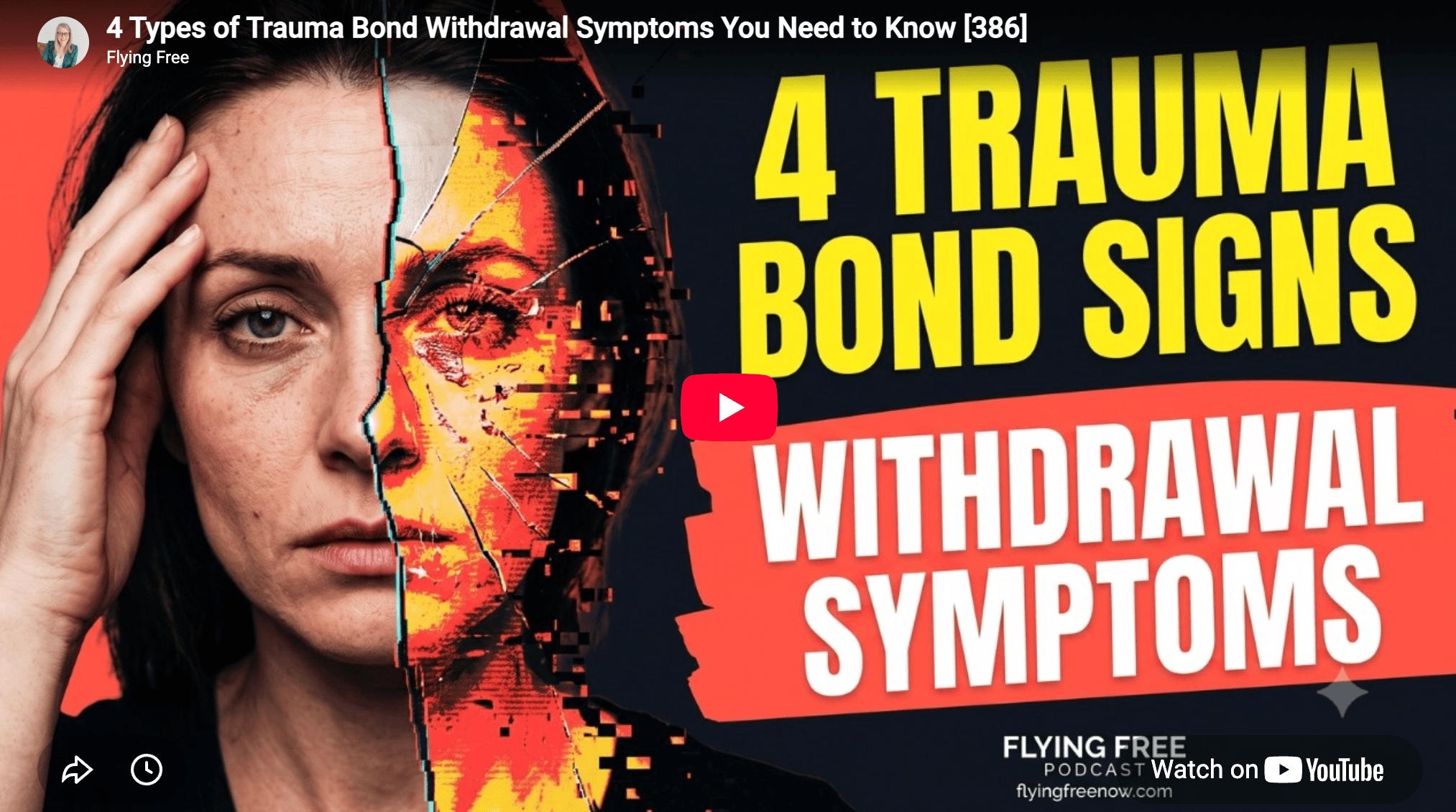
If you are stepping away from an emotionally or spiritually destructive marriage and suddenly feel hit by severe anxiety, physical illness, obsessive thoughts, or a desperate urge to run back, you may be experiencing trauma bond withdrawal.
When a relationship alternates between unpredictable emotional mistreatment and periods of seeming “niceness,” your body builds a biological and neurochemical dependency on that cycle. Breaking free triggers a physical and emotional detox.
Today’s episode is a faith-informed, clinically grounded guide to understanding trauma bond withdrawal symptoms, dismantling weaponized scripture, and restoring your nervous system.
Resources mentioned in this episode:
The Grey Rock Method for Emotional Abuse Victims
Flying Free Kaleidoscope Program
Get Today’s Free Resource:
Are you wondering what is happening inside your own painful and confusing marriage? I wrote a book just for you called Is It Me? Making Sense of Your Confusing Marriage. Get a free chapter by going to isitmebook.com
I will also send you my weekly Hope Letters for Christian women in emotionally and spiritually abusive marriages.
Article: 4 Types of Trauma Bond Withdrawal Symptoms You Need to Know
The following is a summary/overview of the content in today’s episode. Please listen or watch for more comprehensive learning.
If you’ve ever left an abusive marriage and then gone back, and then left again, chances are there is something happening in your body that has a name, and today we’re going to hopefully gain some understanding around that.
What Is a Trauma Bond?
Dr. Patrick Carnes, the researcher who first defined this term, described a trauma bond as an intense psychological attachment created by repeated cycles of abuse, betrayal, and mistreatment with some warmth, affection, and validation thrown in here and there. A trauma bond is not real love. It’s a biological attachment loop that forms when the very person your brain looks to for comfort and safety becomes the source of the threat.
Why Does This Feel Like Love When It Isn’t?
Hitting the jackpot on a slot machine releases dopamine, and so does having those “good times” with someone who has mistreated you. The “reward” in both cases is unpredictable, which makes that dopamine hit even more powerful. I remember going to my room after a big fight, feeling despair so deep it bordered on suicidal, and then slowly feeling a little strength return. I knew that if I apologized and took full responsibility, we would reconcile, and I would feel enormous relief. I chased that relief. Add in cortisol and adrenaline from the tension itself, plus oxytocin, the bonding hormone released during apologies and moments of intimacy, and you get a rollercoaster that mimics passion so intensely it can make a calm, healthy relationship feel boring by comparison.
What Conditions Create a Trauma Bond?
There are four core conditions that have to be present to create a trauma bond. The first is intermittent reinforcement, the alternating cycle of unpredictable cruelty and unpredictable affection. The second is a power imbalance, where one person holds dominant control over safety, resources, status, and emotional validation. The third is a state of chronic high threat or stress, where your nervous system lives in fight, flight, or freeze. And the fourth is isolation, which in Christian homes rarely looks like being locked away. More often it looks like guilt trips for spending time with your sister, or the quiet self-isolation you impose on yourself because you’re trying so hard to be a good, selfless Christian woman that you stop doing the things and seeing the people you love.
How Do You Know If You’re Trauma Bonded?
You’ll only recognize a trauma bond when you can look past your big feelings, which are real but are not facts, and objectively examine the patterns. Walking on eggshells, constantly monitoring your own behavior so you don’t set him off, is one. Defending him, not just to others but to yourself, is another. So is fixating only on the good times and romanticizing the relationship in your mind. Feeling addicted to someone who treats you badly, watching your boundaries erode because you were taught boundaries aren’t very Christian, and keeping secrets from people who love you because you know they’d be alarmed are all signs of a trauma bond.
What are Some Signature Trauma Bond Withdrawal Symptoms?
Withdrawal from a trauma bond is real, and it’s why the average survivor leaves and returns seven times. There are four categories. Physically, you might experience insomnia, nausea, panic attacks, chest tightness, extreme fatigue, and even body aches. Emotionally, you might face severe despair, suicidal thoughts, profound worthlessness, guilt, and existential terror. Cognitively, you’ll ruminate constantly, idealize the abuser the way the Israelites longed for the onions and leeks of Egypt, doubt yourself, and lose your sense of identity. Behaviorally, you might find yourself checking his social media or fighting the urge to reach out, simply because contact would make the unbearable feelings stop.
Wait, Are You Saying I’m Addicted to Abuse?
No. I want to be crystal clear about this. Abuse victims are not addicted to abuse. Your body is addicted to the relationship, to the chemical loop it created, not to the pain itself. Understanding that these are genuine withdrawal symptoms is what allows you to normalize what you’re feeling and keep moving forward instead of running back.
How Do You Actually Break a Trauma Bond?
It starts with establishing strict boundaries. If you have no shared children, going no contact is the most effective path. If you share children, the gray rock method, staying polite, brief, and unremarkable in required communication, may be necessary instead. Second, ground yourself in reality by keeping a documented log of what actually happened, so that when you’re tempted to idealize him, you have facts to return to. This is not the same as keeping a record of wrongs. Weaponizing that verse against abuse victims is not what Jesus was about. Third, regulate your nervous system through somatic practices like breathwork and physical movement, so your amygdala can calm down enough for your prefrontal cortex to come back online and help you think clearly. Fourth, pursue trauma-informed therapy. Modalities like EMDR, somatic experiencing, internal family systems, and cognitive behavioral therapy are evidence-based and have helped me personally and countless women I’ve worked with. Fifth, rebuild your support network and your identity by reconnecting with safe people and returning to the parts of yourself, hobbies, interests, your own sense of agency, that got lost along the way. Sixth, practice self-compassion. A trauma bond is not a character flaw. It’s a predictable biological response to an unpredictable, harmful situation, and it can happen to anyone.
What Role Does CBT Play in Healing?
Cognitive behavioral therapy is one of the most effective tools for unhooking from a trauma bond because it targets the distorted thinking that keeps the bond alive. It teaches you to identify thoughts like “these intense feelings mean he’s my soulmate” as glitches in logic rather than facts. It helps you separate what’s true from what you feel, so you can say, “I am experiencing dopamine withdrawal, and it feels like love, but my safety is actually at risk.” It also helps you spot minimizing, spiritualizing abuse in the name of picking up your cross, selective memory of only the good moments, and self-blame, and replace those distortions with grounded, balanced thinking.
In my own healing, everything shifted when I recognized the little girl I used to be, still inside me, waiting for someone to step up for her. I realized God was calling me to be that person for myself. The more seriously I took that calling, the more impact I was able to have on the people I love most. You cannot pour from an empty cup, and you cannot give real, authentic love from a place of scarcity.
If you’re ready to do this healing work, with me and with hundreds of other women walking the same road, come join us at joinflyingfree.com. It’s about a dollar a day, and it just might change everything.
XOXO,
Natalie