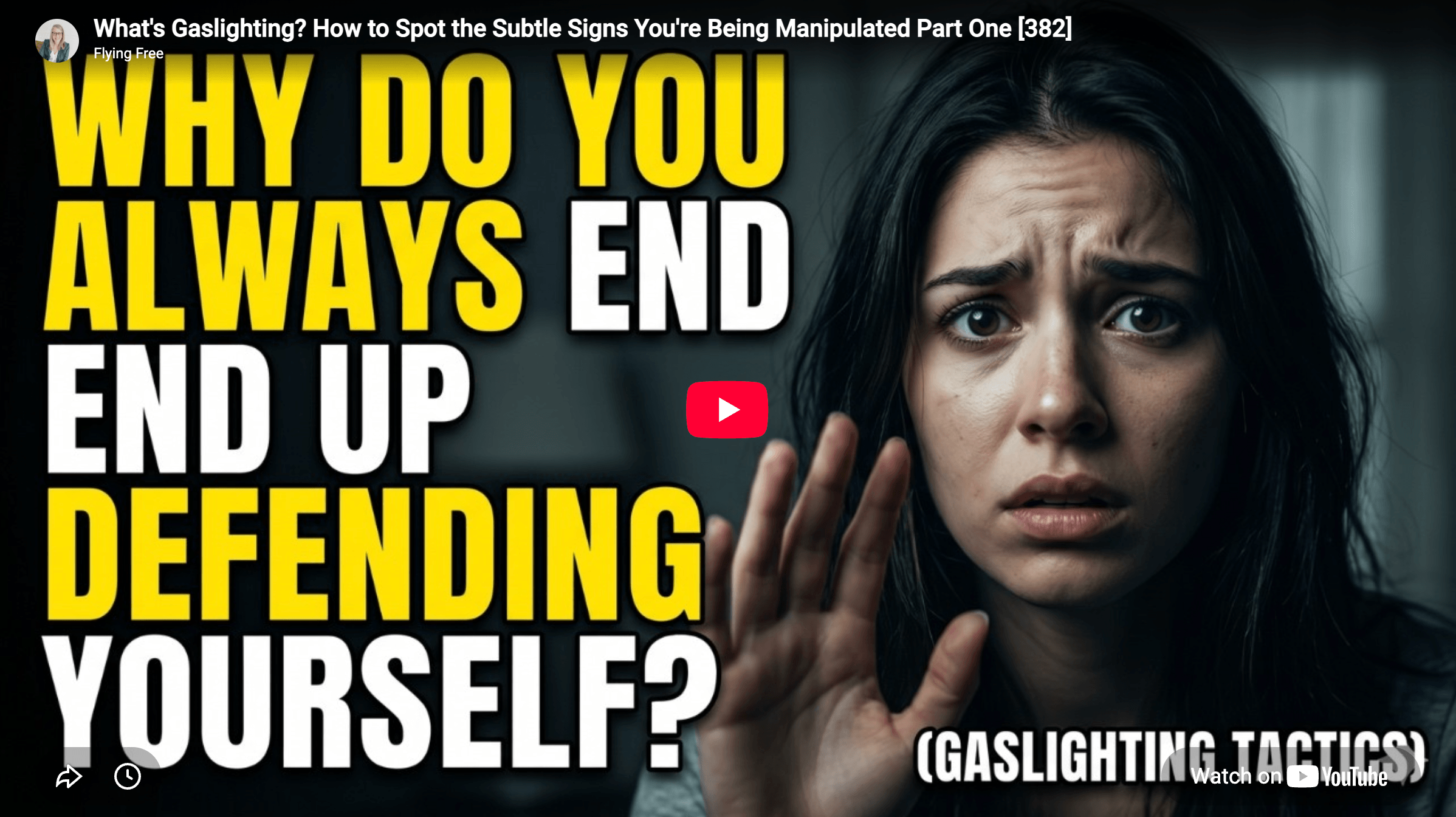
Today we’re going to talk about one of the most disorienting experiences Christian women in emotionally abusive marriages face: gaslighting.
But we aren’t going to just define what gaslighting is. I’m going to break it down into all the tiny parts and give you some specific stories so you can see exactly what’s going on and WHY.
You’ll learn three specific tactics gaslighters use, why they use them, and what you can do to stay grounded in your own reality when someone is working hard to pull you out of it.
Key Takeaways:
- Why someone can sound completely loving and caring while actually doing something deeply harmful to you
- The hidden reason your concerns keep disappearing from conversations before they ever get resolved
- What a “joke” has to do with control, and why your body’s reaction is not a character flaw
- The psychological mechanism you share with a slot machine, and what it’s actually costing you
- The one shift that strips a gaslighting tactic of all its power, without you having to win a single argument
Get Today’s Free Resource:
Are you wondering what is happening inside your own painful and confusing marriage? I wrote a book just for you called Is It Me? Making Sense of Your Confusing Marriage. Get a free chapter by going to isitmebook.com
I will also send you my weekly Hope Letters for Christian women in emotionally and spiritually abusive marriages.
Article: What’s Gaslighting? How to Spot the Subtle Signs You’re Being Manipulated Part One
If you’ve ever walked away from a conversation with your husband feeling more confused than when you started, more uncertain about what you saw, what you heard, what you felt, you’ve probably experienced gaslighting.
What’s gaslighting? It’s an ongoing pattern of psychological manipulation specifically designed to make you doubt your own perception of reality. The end goal is to erode your self-trust so completely that you begin depending on the person who is gaslighting you to tell you what is actually true.
People who have very little self-trust are easy to manipulate and control. Gaslighters want to control you, so they chip away at your ability to trust yourself.
What Does the Fake Concern Gaslighting Tactic Look Like?
In this episode I talk about the “pretend-to-be-concerned” tactic. You come to your husband with an issue such as something he said or did that genuinely hurt you. You want connection and honesty, which is a completely healthy thing to want in a marriage.
But instead of engaging with what you brought up, he looks at you and says something like, “Honey, I’ve been really worried about you. I’ve noticed you’ve been forgetting things lately. I’m not saying this to be mean. I just love you and think maybe you should see a doctor. Do you think you’re going through menopause?”
He has not yelled at you. He has not accused you of anything. He sounds genuinely concerned, maybe even sweet. But here is what actually just happened: your original concern got swapped out for a question about the health of your brain. And now, instead of talking about what he did, you are thinking about whether your memory is failing, whether perimenopause is affecting your thinking.
He is not actually worried about you. He is protecting himself. When you bring up a concern about his behavior, he experiences it as an existential threat. His response is not to engage with your reality. His response is to dismantle it.
Here is the real tell: a husband who genuinely believed his wife was showing signs of serious cognitive decline would bring that up in a dedicated, careful, private moment. He would not bring it up in the middle of a conversation where she has just asked him to be accountable for something he did. The timing and the context are everything.
When he consistently dismisses your concerns about his behavior, and you end up defending yourself instead, that is the pattern you need to look for.
You do not need to defend your memory. The moment you engage with his framing, you have stepped into his version of reality and agreed to argue on his terms. Instead, name what is happening and return to the original topic. You can say, “I hear that you’re concerned about me, and we can talk about that separately. Right now, I want to finish the conversation I started.” That is not harsh or dramatic. That is you staying grounded in what you know.
Why Do “Just Joking” Comments Hurt So Much?
The second gaslighting tactic is the cruel comment disguised as a “joke”. Your husband makes a remark at dinner, maybe in front of friends, something that targets exactly the part of you that you already feel insecure about, or something that really matters to you, because he knows what those things are. You have trusted him with them. And when you react, when your face goes red and you say, “That wasn’t very nice,” he comes back with, “Are you serious? It was just a joke. You’re so sensitive. Lighten up.”
What he is doing is chipping away at you, one small jab at a time. Not one big blow, because that might be too obvious. Hundreds of tiny ones across the years trains you to absorb his contempt without reacting.
It trains you to believe that your healthy emotional response to being diminished is actually a character flaw.
Over time, you start to believe you are too sensitive, too high-maintenance, too exhausting. You make yourself smaller. You suppress the pain. And the smaller you get, the more it works, because you are becoming easier to control.
You need to know that your emotional response to contempt is accurate, wise perception. You are seeing and feeling things correctly.
You do not need to win the debate about whether or not it was a joke. You can simply say, “I don’t find that funny. Please don’t speak to me that way.” If he escalates and calls you sensitive, you do not have to take that bait. “You can think I’m sensitive. I still don’t want to be spoken to that way.” You are not asking him to agree. You are stating the truth and holding it. A man who genuinely loves you and accidentally says something that lands wrong will feel terrible about it. He will not double down by calling you too sensitive to “take a joke.” That doubling down tells you you’ve just been gaslit by a gaslighter.
What Is the “Nice Guy” Gaslighting Trap and Why Does It Work So Well?
The third tactic is SO disorienting. You have had a hard week with your husband. He was cold, dismissive, cutting. He never apologized. So you’ve been pulling back, trying to protect yourself, trying to sort out what you are feeling. And then, out of nowhere, he comes home with flowers. He planned a date night. He is warm and funny and present and looks you in the eyes and tells you he loves you.
You feel a ton of relief flood over you, and everything inside you goes: “See? This is who he really is. I must have been making the rest of it up.”
What you are experiencing is called intermittent reinforcement, the same psychological mechanism that makes slot machines addictive. Consistent rewards are far less powerful than unpredictable ones. When you never know whether the lever is going to pay out, you keep pulling. You cannot stop pulling because…dopamine.
But the good moments are not evidence that your concerns were wrong. They are actually the mechanism that keeps you attached, addicted, confused, and hoping.
You believe the good version is the real version because you want to believe it. Because the alternative, that both versions are equally real and that you have no control over which one shows up, is almost unbearable to accept. That is the reality of loving someone and not wanting to face what you are facing.
But here is the truth: both versions of him are real. The man who brings you flowers and the man who twists your words and dismisses your concerns are not separate people. They are one person who behaves in two different ways.
Love is not measured in the high moments. It is measured in consistent treatment over time. A relationship is not good because it has some wonderful days. It is good when even the ordinary days are characterized by mutual respect and care.
You can receive his kindness as kindness without resetting your grievances. You do not have to throw the flowers on the floor to stay honest about what you know. You can be warm in the moment and still hold the full picture of what has been happening. Keep tracking the patterns. Do not tear out the journal pages.
When you stop resetting every time he is kind, that is when the fog starts to lift. That is when you begin to see the whole cycle for what it is: harm and reward, harm and reward, over and over. And once you can see the cycle clearly, it loses its power to confuse you. That is not you becoming cold or guarded. That is you becoming a clear, wise adult woman who knows what is actually happening in her own life.
What Do You Do When You Are Living Inside This Gaslighting Pattern?
Understanding these tactics is the beginning, not the end. Knowing what gaslighting is does not immediately make it stop, and naming it does not always make a gaslighter change. But it does something just as important: it keeps you grounded in your own reality when someone is working hard to pull you out of it.
The more you practice staying in your own reality, the easier it becomes. These tactics only work when you absorb them, agree to them, and step into the gaslighter’s framing. When you stop doing that, when you name what is happening without drama and return to what you know, the tools lose their grip.
There are more tactics coming in part two of this episode next week, including the defensive pivot, weaponized marital duty, and weaponized forgiveness. But in the meantime, if you are recognizing your own marriage in what you have read here, just know that you are not alone in that experience.
If you’re ready to learn and get clear and strong and confident in who God created you to be, consider joining Flying Free. I’ve helped thousands of Christian women make massive strides in their spiritual and mental health journey, and I’m confident I can help you, too. Go to joinflyingfree.com to learn more.
You were made to know your own reality. You were made to trust yourself.
XOXO,
Natalie